Your Ad Here

Thailand analysis: 'land of smiles' becomes land of lies


Thailand, sad to say, is in a terrible mess. With the very future of the monarchy at risk the stakes could not be higher. The country is deeply polarised with goodwill, moral authority and the truth itself in desperately short supply. Thailand could be heading for a very hard landing.

05 Apr 2009
By Thomas Bell in Bangkok
The Telegraph (UK)


One side is led by Thaksin Shinawatra. The former telecoms billionaire and deposed prime minister is a dubious champion of democracy. During his six years in power Mr Thaksin launched a "war on drugs" in which up to 2,000 alleged dealers were summarily executed by the police.
In government he was dogged by corruption allegations, apparently unable to distinguish his own business interests from those of the country. He was no friend of the free media, although censorship is worse now than it was in Thaksin's day.

On the other side is... who? Mr Thaksin has many vehement enemies among the middle and upper classes. It is difficult to tell how many because in Thailand opinion pollsters never ask the only question that really counts – who would you vote for?

They particularly object to Thaksin's alleged corruption and his government's challenge to Thailand's rigid social hierarchy. Qualms over the deadly "war on drugs", on the other hand, are mostly limited to hand-wringing foreign liberals.

These well-healed opponents control most major institutions. They also claim they are acting to "protect the king", and this is where it gets difficult.

Strict laws make any criticism of the monarchy punishable with up to 12 years in jail – in practice almost any discussion of the monarchy is prohibited. Last week a man, the breadwinner for his family, was jailed for 10 years for posting "insulting" pictures of the royal family online.

King Bhumibol, 81, is "above politics" and he is widely and sincerely loved. Many Thais credit him with steering their country's modern development and intervening to solve periodic crises. The country's official doctrine of "sufficiency economics" is the king's own invention.

When politicians claim to act in the king's name they often accuse their opponents of disloyalty, potentially punishable by 12 years in jail. That can make politics very hard to talk about. Bhumibol, for his part, has been mostly silent.

In 2006 Mr Thaksin was accused of disloyalty to the king and overthrown by a military coup. Nevertheless, with Thaksin in exile, voters returned his supporters to power in elections at the end of 2007.

Mr Thaksin's one great virtue as a democrat is that he and his supporters have won each of three elections so far this decade. He is popular because for the first time in Thai history he campaigned on policies aimed at the rural majority – and then delivered. He earned massive admiration for schemes such as affordable health care.

The pro-Thaksin government elected after the coup lasted less than a year. Protesters, some of them armed with golf clubs, bombs and guns, overran first Government House and then both Bangkok's airports, costing the economy untold millions. They wore the royal colour, yellow, and claimed they were acting to protect the king from Thaksin's alleged republicanism. The movement received the public endorsement of the queen.

The People's Alliance for Democracy, as the movement is misleadingly called, argued that democracy does not work in Thailand because the peasantry are too simple to vote. They want a "new politics" in which 70 per cent of parliament is appointed.

Last year's protests found widespread support among the conservative media which, in its rush to finish the Thaksinites for ever, abandoned factual reporting.

Thaksin denies that he is a republican, although some of his supporters undoubtedly are – or they are now.

At the end of last year a court dissolved the elected government and the army brass summoned political bosses to hoist a new prime minister, Abhisit Vejjajiva, to power. The leaders of the airport protests were never punished – one even became foreign minister.

Now Thaksin has dropped his bomb. In live video addresses to rallies around the country he identified two retired generals who are close advisers to the king and a small group of top judges as the conspirators who plotted his 2006 ousting and have allegedly been invisibly pulling Thailand's strings ever since.

The government is in a funk, panicking about how to block the transmissions. The army is said to be furious: Thaksin has broken the omerta and the government could not stop him. Commentators say he has gone too far and newspapers are openly demanding censorship to stop the revelations being heard.

Yet although the people Thaksin named have offered desultory denials, no one is seriously disputing the truth of his revelations. Apparently that it is not the point – in Thai politics the truth is not meant for public consumption.

Thailand aspires to be a serious country, a Western ally and a destination for tourists and investment, yet in the past few years the "land of smiles" has been more like the land of lies. A light cast on what takes place in the comfortable sitting rooms of power is long overdue.


Read more!

Khmer Rouge confessions 'rarely true' admits Duch


April 7, 2009
Anne Barrowclough
Times Online (UK)


Confessions extracted under torture in the Khmer Rouge's brutal prisons were rarely true, the regime's prisons chief admitted today.

Kaing Guek Eav, or 'Duch' the director of the Khmer Rouge's most infamous prison S-21, told a Cambodia war crimes tribunal he took part in torture sessions and ordered his subordinates to beat prisoners who were to be 'smashed' to death with an iron bar.
Duch was renowned for reading every confession brought to him from the interrogation sessions, often correcting them in red pen. However, he said today, he rarely believed them.

"I never believed the confessions I received told the truth. At most, they were about 40 percent true," he told the Extraordinary Chambers of the Courts of Cambodia (ECCC) in the Cambodian capital Phnom Penh.

The 66-year-old former school-master is in the second week of a hearing at the UN-backed tribunal, charged with crimes against humanity, war crimes, torture and homicide.

He has already accepted responsiblity for the atrocities committed at S-21 under his command, and apologised to his victims but he maintains that he was a scapegoat of Pol Pot's genocidal regime which presided over the death of 1.7 million Cambodians during its 1975 - 1979 rule.

The former school-master is answering questions about M-13, a secret security centre in the jungle he ran from 1971-1975 during the Khmer Rouge insurgency against the US-backed military government.

He was posted to S-21 after impressing his superiors with his fanatical devotion to the communist cause, and his brutally meticulous directorship of M-13.

He told the court M-13 was surrounded by a bamboo fence and shackled prisoners were often held in two-metre deep pits, both to prevent escape and to protect them from US warplanes carpet-bombing the area

He claimed he personally tortured only two people but admitted: "The burden is still on me - it's my responsibility. I would like to apologise to the souls of those who died," he said.

The ECCC is questioning him over M-13 to get a better understanding of the structure of S-21.


Read more!

Photos from Preah Vihear border: Damage to Preah Vihear and Cambodian village


Pockmarked holes on the temple rocks resulting from Thai troops shooting (All photos: Samnang, Koh Santepheap news)
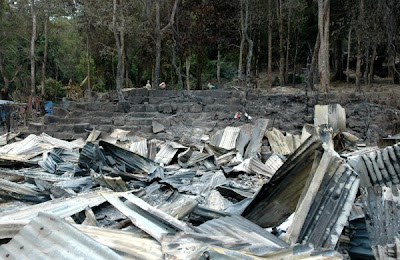
257 Cambodian homes were burnt down to the ground from indiscriminate Thai rocket shelling

Evacuated villagers
Villagers evacuated to safety zone


Read more!

Evacuated villagers from Preah Vihear region face shortage


Refugees evacuated from the fighting zone are asking for help because their homes were all destroyed from the clash (Photo: Uy Sophea, RFA)

06 April 2009
By Savyouth
Radio Free Asia
Translated from Khmer by Socheata
Click here to read the article in Khmer


The short clash between Cambodian and Thai soldiers on 03 April led to more than 300 Cambodian war refugee families.

More than 300 Cambodian families living in the village at the foothill of Preah Vihear temple and who are now war refugees from the fighting zone, were temporarily evacuated to Sra’Em village, Kantuot commune, Choam Ksan district, Preah Vihear province. These families now face shortage of food, housing, clothing, and household cooking utensils because more than 250 of their homes were burnt down during the clash between Cambodian and Thai troops.

On Monday 06 April, a group of villagers who are now living in makeshift tents and in a market building said that their belongings and household utensils were all burnt down because of Thai troops rocket shelling.

Siv On, an elder man sitting underneath a tarp sheet, said that his home was burnt down, and his loss amounts to more than $10,000. “I lost my house and my belongings. The loss amounts to more than $10,000. We could not get anything out, we could only save ourselves and we thought that nothing will happen to our homes.”

Another villager said with tears streaking down her cheeks that her house was completely destroyed by the fire, and when she escaped from the fighting zone, she couldn’t get anything out at all, she was only able to escape with her children and the clothes on their back only: “I lost everything, I don’t even have a short for my children. I came to live here 10 years ago with my husband. They [Thai soldiers] fired [rockets] into houses in the market. I was lucky, if I did not run the trench on time, I would be filled with holes [from rocket shrapnels]. I am very hurt by the Siems [Thais], I don’t know who to tell this to, I can only beg Samdach Dekcho to help the villagers so they can continue their businesses.”

According to local authority, thousands of refugee people are facing difficulties, such as shortage of food, household utensils, clothes, lodging and they are also facing health problems.

On Monday morning, Sor Thavary, the deputy provincial governor for Preah Vihear, said the evacuated villagers lack everything, and he is calling on all humanitarian organizations to help provide for the villagers.

Sor Thavary said: “They lost everything in the fire. Any donations are very appreciated by them, if they can get tents that would be best.”

The authority indicated that the department of social affairs and the Preah Vihear Red Cross have distributed food, mosquito nets and plastic tents in an emergency, but the supplies cannot meet the needs of these war refugees yet.

These war refugees were evacuated by Cambodian troops to safer zones in the evening of 03 April, following the clash between Cambodian and Thai troops near Veal Entry, located close to the Preah Vihear temple.


Read more!

[Thai] Army won't send more troops to temple area [... or so it claims]


Forces will be rotated, tensions ease after talks

7/04/2009
BANGKOK POST AND AFP

The army will not be deploying more troops in the disputed border area in and around the Preah Vihear temple despite the clashes last week with Cambodia, Second Army commander Wiboonsak Neepal says.

Lt Gen Wiboonsak yesterday said instead of pouring in reinforcements, the army would rotate its forces to bring in fresh legs.

The rotation is necessary if morale and confidence is to be boosted in the area which was the scene of last week's clashes.

Tensions look to have eased after talks on Sunday between Suranaree Task Force commander Kanok Netrakawesan and Maj Gen Srey Doek, head of Cambodia's military division 3.

The two generals arm wrestled after their talks to ease tensions between the two armies.

Maj Gen Kanok said the two countries had no plan to withdraw their troops from the area, so the possibility of future confrontation could never be ruled out.

Nothing could be taken for granted no matter how disciplined the soldiers, he said.

Two Thai troops and two Cambodians were killed in the fighting on Friday. Another 10 Thai troops were injured, one seriously. The clashes took place in a 4.6 sq km area claimed by the two sides.

Thailand claims the area is in Kantharalak district of Si Sa Ket, while Cambodia insists it is in Preah Vihear province.

Defence Minister Prawit Wongsuwon will hold talks with his Cambodian counterpart Tea Banh aimed at preventing more clashes at the general border committee meeting in Siem Reap on April 27-28, an army source said.

The two neighbours have also started joint boundary commission talks in Phnom Penh aimed at resolving competing claims surrounding the Preah Vihear temple.

"The incidents that have happened show that the border issue needs to be resolved very quickly in order to avoid more incidents," Var Kim Hong told reporters before the talks.

Var Kim Hong co-chairs the committee with Thailand's Vasin Teravechyan.

The last meeting of the JBC ended in February with the two sides failing to reach an agreement on any of the key points, including the spelling of Preah Vihear in official documents.

Cambodia insists on using Preah Vihear while Thailand wants to refer to it as both Preah Vihear and Phra Viharn.

The World Court in 1962 gave ownership of the ruins of the Hindu temple to Cambodia, but tensions flared last July when the cliff-top structure was awarded United Nations World Heritage status.


Read more!

Khmer Rouge torture chief says he never wanted to run prison


Mon, 06 Apr 2009
DPA

Phnom Penh - The Khmer Rouge's former chief torturer told Cambodia's UN-backed genocide tribunal Monday he never wanted to become the warden of a notorious prison where more than 15,000 people were sent to be murdered, saying he had hoped to be a teacher after the ultra-Maoist group came to power in 1975. Kang Guek Eav, known by his revolutionary name Duch, was a mathematics teacher before joining Pol Pot's Communist Party of Cambodia (CPK) in the early 1960s and said he had "sacrificed everything," including his job and salary, for the revolution.
"The only thing I loved in life was teaching," he said. "I wished that when the revolution was over I would be able to teach again."

In the tribunal's first trial, Duch, 66, faces charges of crimes against humanity, torture, premeditated murder and breeches of the Geneva Conventions, allegedly committed while he headed the notorious Tuol Sleng torture prison in Phnom Penh.

The born-again Christian last week begged the families of victims and the handful of prison survivors to forgive him for crimes he committed at the school-turned-torture facility.

It was the first time any Khmer Rouge leader or apparatchik had made such an apology.

As the trial entered its second week Monday, judges questioned Duch about his time in the pre-revolutionary CPK and his involvement in the establishment of M-13 - a centre the Khmer Rouge ran during its rebellion against the US-backed military regime from 1971 to 1975.

Duch displayed a sharp memory for dates and names, recalling the exact dates on which he joined the CPK, met various Khmer Rouge members and when he was arrested and detained during the rule of former king and independence leader Norodom Sihanouk.

He said he was sentenced to 20 years prison for sedition in 1968 but was released after General Lon Nol led a coup against the Sihanouk in 1970.

"Lon Nol released political prisoners to show the world that Sihanouk was vicious," he said. "If Richard Nixon did let Lon Nol start the coup and Sihanouk had not become aligned with the Khmer Rouge, then the Khmer Rouge would never have succeeded."

Duch is one of five former leaders facing trial for their roles in the deaths of up to 2 million people through execution, starvation or overwork when the group sought to transform modern Cambodian society into an agrarian utopia, erase history and start again at "year zero" during its 1975-1979 reign.

His trial resumed as United Nations legal officials met with the Cambodian government to discuss an investigation into alleged corruption at the hybrid court, which has been riddled with controversy since it was established in 2006.

Peter Taksoe-Jensen, UN Assistant Secretary for Legal Affairs, and Deputy Prime Minister Sok An have pledged after previous discussions to conduct simultaneous investigations into allegations that Cambodian staff at the court were forced to pay kickbacks to their superiors.

The court has also faced allegations of government interference and disagreement between domestic and international prosecutors over plans to extend the investigation and arrest more former leaders.

Prime Minister Hun Sen said last week that arresting more detainees would put the country at risk of civil war. He said he would rather see the court fail than let the country return to conflict.

The court's 500-seat public gallery was about half full Monday, but the national TV network suspended its live broadcast of the court, which had run throughout the previous week's sessions.


Read more!

Preah Vihear: UNESCO is concerned


04 April 2009
By Maxime Revol
Cambodge Soir Hebdo
Translated from French by Luc Sâr

Click here to read the article in French


The national UNESCO commission in Cambodia wrote a letter to its international headquarters to draw its attention on the major damage risks on Preah Vihear temple resulting from the recent clash that took place in this zone.

While the UNESCO indicated that several of its experts are on the spot in Preah Vihear these last few days, it also said that the situation is strongly degrading in the region. Following the clash on 02 April, and the ensuing escalation, UNESCO said that it is extremely concerned by the security of the temple. According to its communiqué, Thai soldiers have burnt a section of the market located at the bottom of the staircase leading to the temple. Shootings have damaged this portion of the site, as well as buildings belonging to Preah Vihear National Authority, located a dozen of meters away from the temple.

The Cambodian branch of UNESCO launched an urgent appeal to its headquarters, trying to push it to intervene officially. Such an intervention is deemed decisive and necessary for the safekeeping of this exceptional site.


Read more!